


Page 61 - Alderville First Nation
P. 61
Harvesting Rights
                  In the treaties written years ago, we were      WORDS TO KNOW
                  given rights to hunt, trap, gather, and fish    pre-Confederation: the period before Confederation
                                                                  in Canada. Confederation is the name of the event
                  in our traditional lands. Elders say that the
                                                                  in 1867 when Ontario, Québec, Nova Scotia, and
                  treaties have not changed and that these        New Brunswick joined together to become a nation;
                  rights were continuous.                         later other provinces and territories became part
                                                                  of Confederation.
                  As part of the treaty negotiation process,      Supreme Court: the highest most important court in
                                                                  the country
                  both parties have taken the issue of hunting,
                  trapping, gathering, and fishing rights to the
                  courts for a ruling.

                  In 1984, the Supreme Court ruled against
                  the Hiawatha First Nation, declaring that the
                  Williams Treaties extinguished their harvesting
                  rights flowing from Treaty No. 20. (See page 68
                  of the Resources section for more information
                  about numbered treaties.) The Supreme Court’s
                  judgment was enforced by Ontario against
                  our First Nation as well. In our opinion, this
                  right was protected by the Constitution Act
                  of 1982. As part of the treaty negotiation and
                  court process, the parties agreed that Williams
                  Treaties did not extinguish pre-existing treaty
                  harvesting rights in certain pre-Confederation
                  treaties.  Between 1923 and 2018, the Williams
                  Treaties First Nations were prevented from
                  exercising harvesting rights. In 2018, the
                  Williams Treaties settlement agreement finally
                  recognized constitutionally protected pre-
                  Confederation harvesting rights.

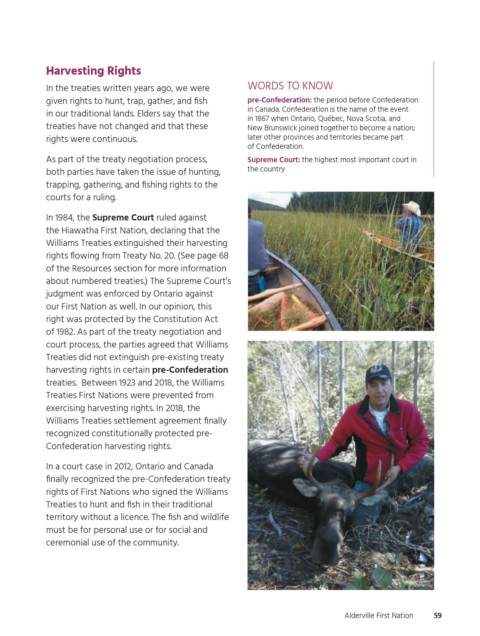
                  In a court case in 2012, Ontario and Canada
                  finally recognized the pre-Confederation treaty
                  rights of First Nations who signed the Williams
                  Treaties to hunt and fish in their traditional
                  territory without a licence. The fish and wildlife
                  must be for personal use or for social and
                  ceremonial use of the community.


                                                                                         Alderville First Nation  59


          ogemawahj_community_book3.indd   59                                                               2019-02-28   10:57 AM

